
PubMed, MEDLINE, Embase and Reactions Weekly – a practical comparison.
Access to reliable scientific data is essential for professionals working in pharmacovigilance, regulatory affairs, clinical research, and evidence-based medicine. Among the most widely used biomedical databases are PubMed, MEDLINE, Embase, and Reactions Weekly. While they are often mentioned together, each serves a distinct purpose and offers different strengths.
This article provides a clear comparison to help researchers and industry professionals choose the most appropriate source for their needs.
PubMed – broad access to biomedical literature
PubMed is a freely available platform developed by the U.S. National Library of Medicine. It serves as a gateway to a vast collection of biomedical literature.
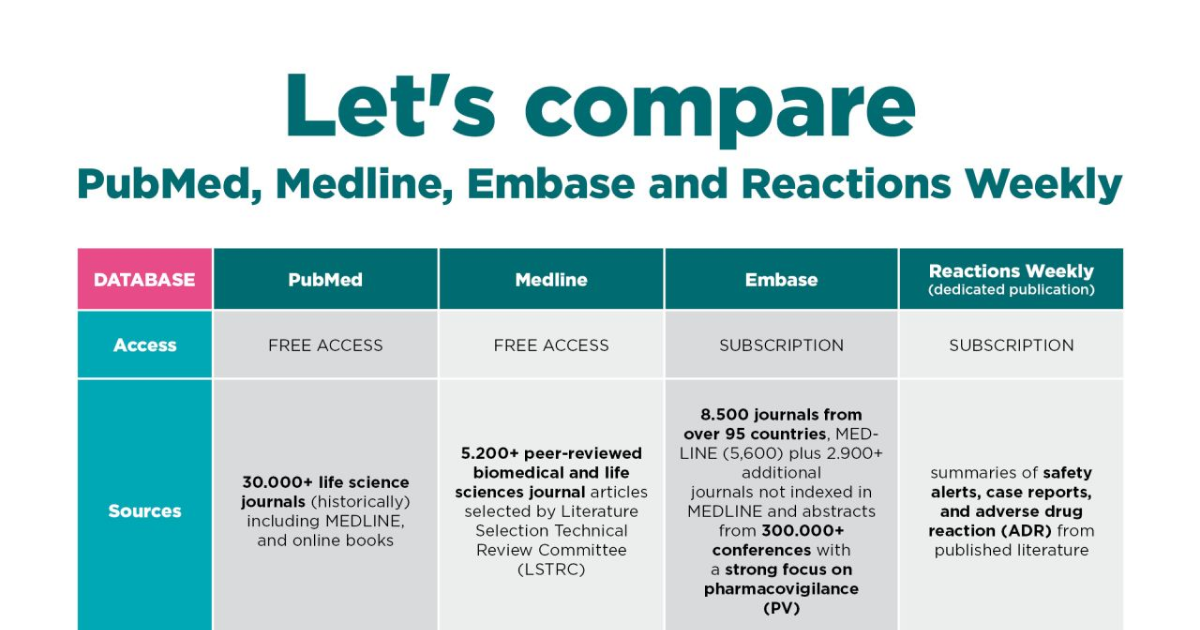
It includes more than 30,000 life science journals and contains over 38 million citations and abstracts. A significant advantage of PubMed is its integration with PubMed Central, which provides access to more than 10 million full-text articles.
PubMed supports both simple and advanced search, including Boolean operators, filters, and limits such as publication date, study type, and language.
In practice, PubMed is widely used for literature searches, systematic reviews, and general research across medicine, pharmacy, and healthcare.
MEDLINE – curated subset with controlled vocabulary
MEDLINE is a curated subset of PubMed, also maintained by the U.S. National Library of Medicine. It contains over 5,200 peer-reviewed journals selected through a rigorous review process.
What distinguishes MEDLINE is its use of Medical Subject Headings (MeSH), a controlled vocabulary that enables precise and consistent indexing of articles.
Although MEDLINE contains around 30 million references, its strength lies in data quality rather than volume. The structured indexing allows for more accurate and reproducible searches, which is particularly valuable in systematic reviews and evidence-based medicine.
MEDLINE is often preferred when high-quality, well-indexed literature is required.
Embase – comprehensive coverage with strong focus on pharmacology
Embase, produced by Elsevier, is a subscription-based database known for its extensive coverage and strong emphasis on pharmacology and drug research.
It includes over 8,500 journals from more than 95 countries, as well as content not indexed in MEDLINE. In addition, Embase provides access to abstracts from over 300,000 conferences, which is particularly valuable for identifying emerging research.
The database contains approximately 45.6 million records, with more than 8,500 new entries added daily. Its indexing system uses Emtree, a controlled vocabulary similar to MeSH but with greater depth in drug and pharmacovigilance terminology.
Embase is especially useful for:
- comprehensive literature reviews,
- drug development and regulatory submissions,
- pharmacovigilance activities.
Its inclusion of grey literature and broader international coverage makes it a critical resource for in-depth research.
Reactions Weekly – focused insight into drug safety
Reactions Weekly is a specialized publication by Springer Nature, dedicated to drug safety and adverse drug reactions (ADRs).
Unlike the other databases, it does not aim to provide comprehensive literature coverage. Instead, it delivers curated summaries of:
- safety alerts,
- case reports,
- adverse drug reactions,
- regulatory updates,
- clinical trial safety findings.
Access to Reactions Weekly requires a subscription, and its search functionality is more limited compared to traditional databases. However, its value lies in its focused, up-to-date reporting on pharmacovigilance issues.
This resource is particularly relevant for professionals working in:
- pharmacovigilance,
- drug safety monitoring,
- regulatory affairs,
- signal detection.
Key differences at a glance
The main distinctions between these resources can be summarized as follows:
- Access: PubMed and MEDLINE are free; Embase and Reactions Weekly require a subscription.
- Scope: PubMed offers broad coverage; MEDLINE provides curated content; Embase delivers the most comprehensive dataset; Reactions Weekly focuses exclusively on drug safety.
- Indexing: MEDLINE uses MeSH; Embase uses Emtree; PubMed combines multiple sources; Reactions Weekly is editorially curated.
- Use cases: PubMed for general research; MEDLINE for precise searches; Embase for comprehensive and pharmacology-focused analysis; Reactions Weekly for safety monitoring.
Choosing the right database for your needs
The selection of a database should be driven by the specific objective of the search.
For general literature exploration or academic work, PubMed is often sufficient. When precision and methodological rigor are required, MEDLINE provides a reliable foundation. For comprehensive reviews, especially in pharmacology and drug development, Embase is indispensable. Finally, for ongoing monitoring of drug safety and adverse reactions, Reactions Weekly offers targeted and timely insights.
In many cases, combining multiple sources yields the most robust results, particularly in regulatory and pharmacovigilance contexts where completeness and accuracy are critical.
Conclusion
Understanding the differences between PubMed, MEDLINE, Embase, and Reactions Weekly is essential for effective information retrieval in the life sciences. Each database contributes unique value, and their complementary use allows for a more comprehensive and reliable evidence base.
For organizations operating in pharmacovigilance and regulatory environments, selecting and combining the right tools can significantly improve the quality of analysis, decision-making, and compliance.
